Recently at Opuscope we had the privilege to explore the new Google Maps Photorealistic 3D tiles API.
We started experimenting with the ability to anchor digital content on top of the physical world in 2015, with the HoloLens' Anchoring APIs. It opened up a world of possibilities and we then decided to focus a lot of our time helping creators build AR persistently anchored experiences. As we built Minsar Studio around this capability we were always keen on trying new technologies. In 2018 we had added support for anchoring though 6D.AI's APIs (the company was later acquired by Niantic to power the Lightship SDK), and then Azure Spatial Anchors in 2020.
Despite this being one of the most exciting use-cases for AR, the tech always quickly showed many shortcomings. Both Azure Spatial Anchors and Google Cloud Anchors need the end-user to manually scan the surrounding environment with their phones in order to gather precious world information, which is required for the anchoring and relocalization processes. Unfortunately, what we noticed since 2018 is that this task is simply too cumbersome and complicated for the vast majority of consumers. It's also time-consuming, and the phone gets warm as it's a resource-intensive process. This results in a lackluster experience which made us yearn for years for a Visual Positionning Service that leverages a vast network of previously scanned locations.
Two years ago Niantic (re)announced its own VPS as part of the Lightship SDK - they decided to rely on their most engaged in-game users (Pokemon Go...) and community enthusiasts to have them scan as many locations as possible. This is a smart play, however this means the VPS-ready locations are very sparse, and where there's environment data (mostly in big cities), it may very well be outdated. You can't blame Niantic for not having the resources to build a fleet of vehicles that regularly take hundreds of thousands of images like Apple, Google and Microsoft do. Their approach is interesting given their constraints.
Then Google announced the much-anticipated Geospatial VPS
Vision Pro: the ultimate entertainment machine, but it needs to be more than that.
! Now anyone can remotely create AR location-based experiences
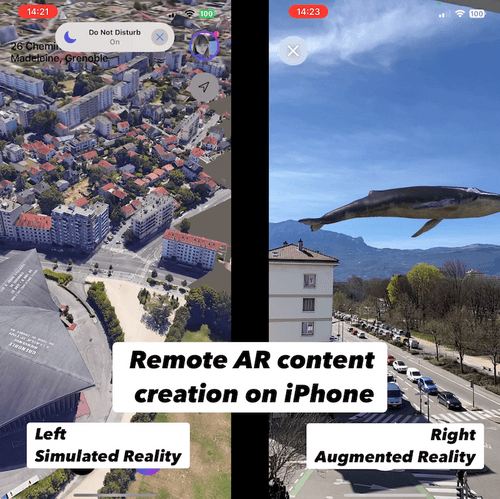
We’ve been experimenting with this new capability in our🤳mobile and 🥽 immersive apps. It’s game-changer for creators and businesses!
Here’s an iPhone demo:
The actual accuracy of Google Geospatial API is seriously impressive, and not just at street-level.